
Rediscovering Your Own Rhythm: Theater as a Compass for Inner Listening
- Mirko Rizzi

- Aug 11
- 3 min read
Updated: Aug 15
We live immersed in a constant digital “background noise.” The frantic rhythm of notifications, the endless scrolling through content, and fragmented attention push us to live primarily in our minds and listen less and less to our bodies. Amid this constant chorus of distractions, we risk losing the ability to recognize our inner rhythm—the breath, the heartbeat, our sense of our own space and time.
But there is a place where we can recover this connection and where the body once again becomes our primary means of understanding: the theater workshop. With its focus on movement, space, and above all rhythm, theater becomes a compass for listening within.
The Body as an Instrument, Rhythm as a Language
In a theater workshop, the body is not simply a vehicle, but the main means through which we explore and express ourselves. The exercises do more than teach movement: they teach participants to inhabit their own bodies again, to feel them, and to understand their potential.
At the heart of this work is rhythm, understood in two dimensions:
Inner rhythm: the most intimate rhythm, linked to breathing and heartbeat, which brings us back to the here and now. It means stopping and sensing what is happening within us, listening to the body before the mind begins to speak.
External rhythm: the rhythm that arises from our relationship with space, music, and others. Working on the rhythm of an action, a dialogue, or a group movement teaches us to tune in and “keep time” together.
The body senses and transmits vibrations: some originate within it, while others come from outside. Even without realizing it, we tend to respond to the rhythms around us: we follow them, resist them, and allow them to speed us up or slow us down.
When we are constantly bombarded by frantic stimuli, we can lose awareness of this response. In the structured space of a theater workshop, however, it becomes part of the work: we can recognize it, change it, and use it to recover our own rhythm or bring it into harmony with the group’s.
From Inner Silence to Collective Harmony
The journey toward awareness in theater begins with an act of inner silence. To listen to others and understand a group’s rhythm, we must first rediscover our own. Rhythmic games and exercises teach us that, to act effectively in a shared space, we must be in tune with ourselves.
But they do more: they also teach us to listen to others and seek a rhythmic harmony that is not merely physical but, for older or more experienced students, extends to dialogue as well. This ability to tune in—so rare in digital interactions, which are often reduced to a succession of monologues—becomes a vital skill for building deep, meaningful relationships.
My background as a musician and drummer often finds its way into my theater work. I introduce rhythmic interactions among participants, including through music, to show how changes in the rhythm of the body and of an action influence the audience’s perception. It is remarkable to see how the same action or relationship can become dramatic or comic simply by changing its rhythm.
An Act of Everyday Awareness
What is learned in a theater workshop does not end when the curtain falls. Anyone who has learned to listen to their body, recover their own rhythm in a moment of stress, and move consciously through space has gained valuable tools for everyday life.
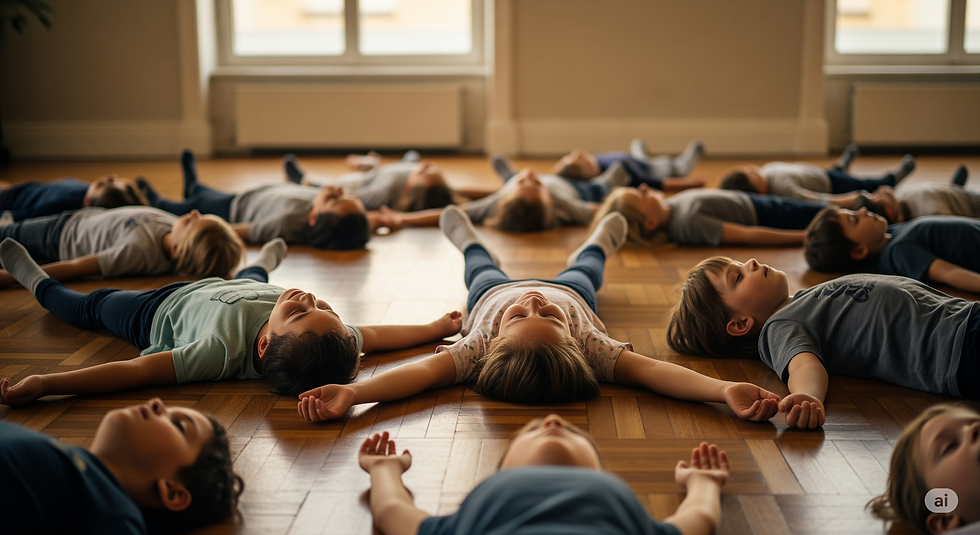
A concrete example is the response I get from The Keys Game, an exercise based entirely on listening and concentration. Even in classes described as “wild,” children ask to play it again and again. Their reaction shows just how rare it has become to experience moments of complete calm and inner listening.
Their desire to play it again does not come from enjoyment alone; it reveals a deep need to recover the calm and concentration that everyday life, often dominated by frantic stimulation, leaves so little room to cultivate.
In this sense, theater is far more than an art form: it is an exercise in presence and humanity in a distracted world. It gives us a compass to keep from losing ourselves in the chaos and to return, whenever we need to, to our inner rhythm.


Comments