
From the Stage to Life: How Theater Defeats the Fear of Being Judged and Cultivates Self-Confidence
- Mirko Rizzi

- Aug 11
- 4 min read
Updated: Aug 15
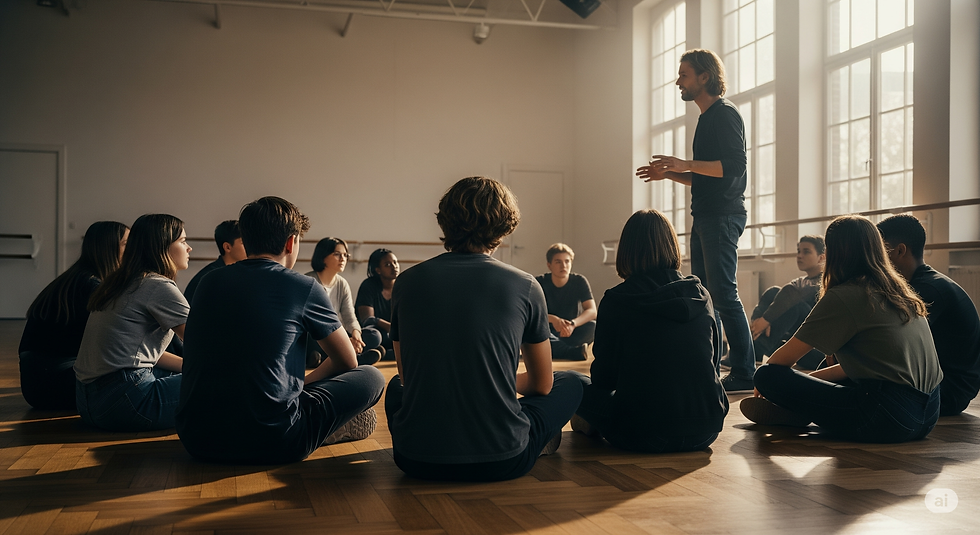
We live in an age of constant display, in which other people’s gaze follows us everywhere. The fear of being judged affects people of all ages, but it can weigh especially heavily on children and teenagers while they are still forming their identities.
Those who grow up immersed in online life are faced every day with idealized images, “likes,” and constant forms of approval. Social media therefore becomes fertile ground for insecurity. Many young people end up feeling inhibited, shy, or afraid to express themselves freely, fearing that they are not “enough” or that they will make a mistake.
But there is an ancient yet ever-relevant place that offers a powerful antidote to this fear: the theater workshop. When led with expertise, theater becomes a vital training ground for self-confidence and creative freedom—a space where judgment is disarmed and authenticity can emerge.
The Stage: A Safe Space for Authenticity
The first great lesson we learn in theater is that the stage can become a safe place. It is not one automatically; it becomes one when an experienced workshop leader creates an atmosphere in which every idea, emotion, and expressive proposal—even the strangest or most imperfect—is welcomed as material to work with, rather than treated as a measure of personal worth.
In this protected space, young people can lower their defenses, take risks, and allow themselves to make mistakes.
As Brazilian theater practitioner and educator Augusto Boal argued:
“Theater is the most complete form of knowledge, because we learn through the whole body, through emotions, and through thought.”
In theater, a mistake is not a failure to hide, but an opportunity for discovery—a part of the creative process. This different relationship with imperfection opens the first crack in the wall of the fear of being judged, a wall that begins to crumble exercise by exercise.
Through a Character: The First Step Toward Yourself
Theater teaches us to give body and voice to a character, but in doing so we also end up giving shape to a part of ourselves. Whether a young person plays someone brave, fearful, angry, or awkward, they are called upon to explore an emotion and make it their own for the duration of the scene.
This process allows young people to encounter and accept their own nuances. Understanding that they can be shy, angry, or awkward without any of those qualities defining their worth is the first major step toward self-confidence.
The stage does not ask us to be perfect; it asks us to be truthful in that moment, within that situation. And it is in that truth that freedom is found.
The Power of Voice, Gesture, and Presence
In a world where communication often takes place through text messages and emojis, theater draws attention back to the importance of physical and vocal presence.
Through exercises in intonation, volume, posture, and gesture, young people learn to use their bodies and voices as powerful tools of expression. This is not merely about technique, but about realizing that their bodies have something to say and their voices deserve to be heard.
This rediscovery of physical presence leads to greater confidence. Self-confidence is not merely a feeling; it is also a way of carrying the body. A young person who learns to take up space, use their voice, and look others in the eye is already reclaiming ground from the fear of being judged.
The Workshop Leader: A Trusted Guide Through Exploration
In this process, the workshop leader’s role is crucial. They are not a judge who evaluates performance, nor someone who merely proposes exercises: they are a guide who accompanies them as they explore themselves, relationships, and emotions.
They create a protected but demanding space in which every student can discover their inner world and learn to recognize and manage what they feel. Guiding them safely does not mean removing every difficulty. It means establishing clear rules, appropriate pacing, and shared forms of expression that allow them to face difficulty without turning vulnerability into exposure.
In this way, the workshop leader helps young people develop the courage to be vulnerable, the ability to make mistakes, and the freedom to create without chains.
When the final applause crowns a performance, it does not confer value on the young people or certify their growth. It celebrates the outcome of shared work. Their confidence was built earlier, throughout the process: each time a student dared to step forward and the group knew how to welcome them.
The Stage of Life: Resilient Young People for an Uncertain Future
Theater, then, is not only an art form but a tool for life. It gives young people a foundation for facing the fear of being judged, recognizing their own authenticity, and taking their place in the world not as passive spectators, but as self-aware protagonists.
But none of this happens simply because someone “does theater.” Training is everything, especially when working with children and teenagers. This is not a role anyone can simply improvise. The quality of a workshop and the depth of its impact on a young person’s life depend on having a professional specifically trained to work with them.
It is this training that distinguishes a simple pastime from a genuine, lasting process of growth.
Stella Adler’s words neatly capture the need to leave the noise of external judgment outside, at least for the duration of the work:
“Over the next few classes, you will hear me say again and again that acting is not about you. But from the very beginning, I want you to know that you matter. You must understand that when you are in this room, the outside world must remain outside. When you are here, you need every part of yourself. You must think only of yourself.”
It is in that space—protected, demanding, and alive—that the fear of being judged loses its power and self-confidence begins to grow.


Comments